
Planning and Environment Committee
Proposed 20mph Speed Limit Scheme for Dorchester
Last year, residents raised concerns with the Town Council about vehicle speeds, pedestrian safety—particularly for children and older people—and the difficulties faced by cyclists travelling around the town. In response, the Council began discussions with Dorset Council (which is legally responsible for highways and setting speed limits) on the potential introduction of a 20mph speed limit in Dorchester and established a task group to explore the available options.
Building on this work, Dorchester Town Council will launch a six-week public consultation on a proposed town-wide 20mph speed limit, running from 23 July 2026 to 7 September 2026.
The proposal aims to make Dorchester safer for pedestrians, cyclists and drivers, improve the local environment, and encourage more people to choose walking and cycling for everyday journeys.
Throughout the consultation, the Town Council will attend public events, provide information about the proposal, and encourage residents to share their views by completing the survey. The Council is also engaging with local businesses, community organisations and other stakeholders to gather feedback on the proposed 20mph scheme for Dorchester.
Where will the proposed 20mph speed limit apply?
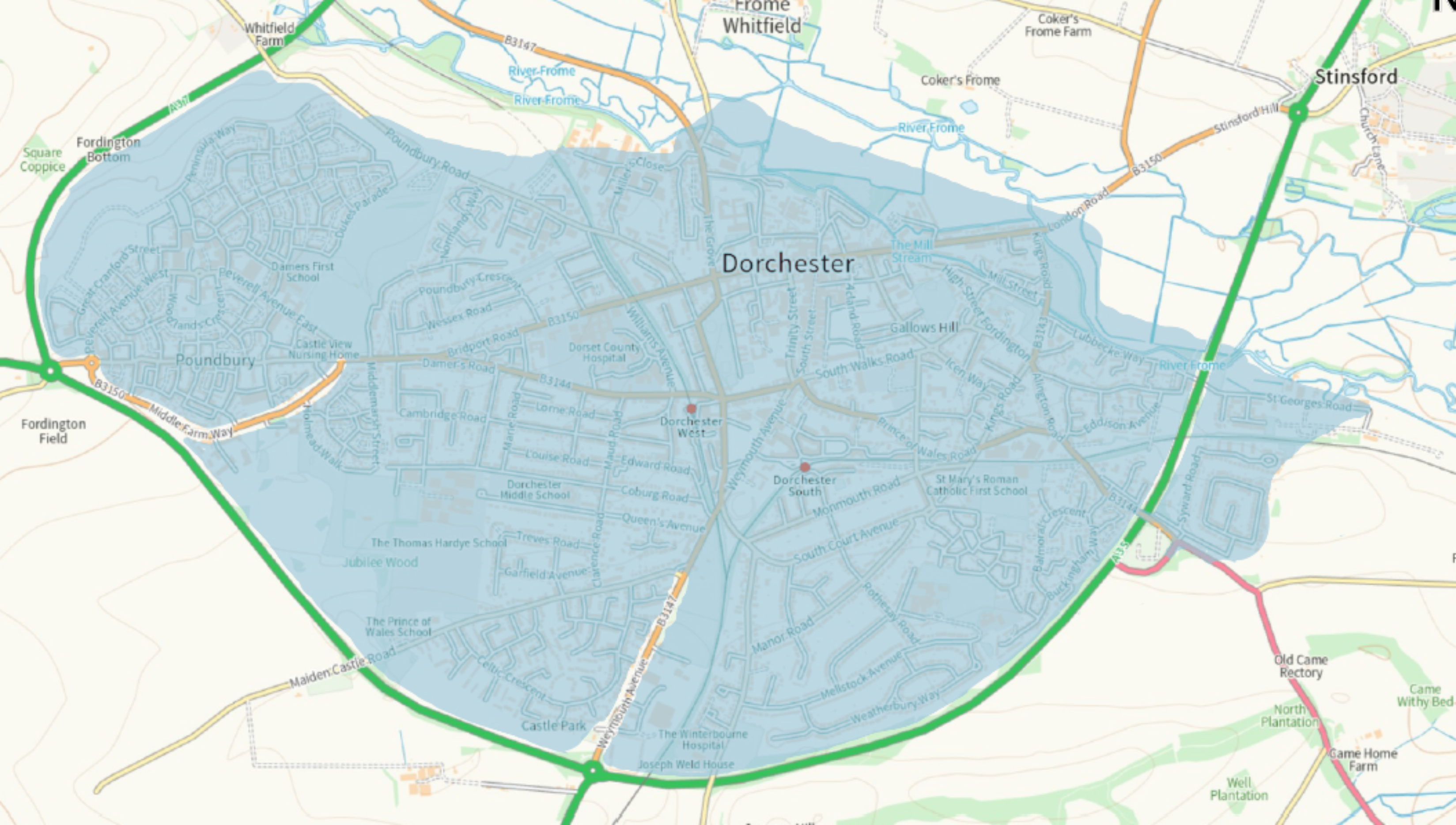
The speed limit will apply across the whole of Dorchester. The proposal covers the main routes within Dorchester and the residential areas to create a consistent and easy‑to‑understand speed environment.
Overview Map of Dorchester and Proposed 20mph Area
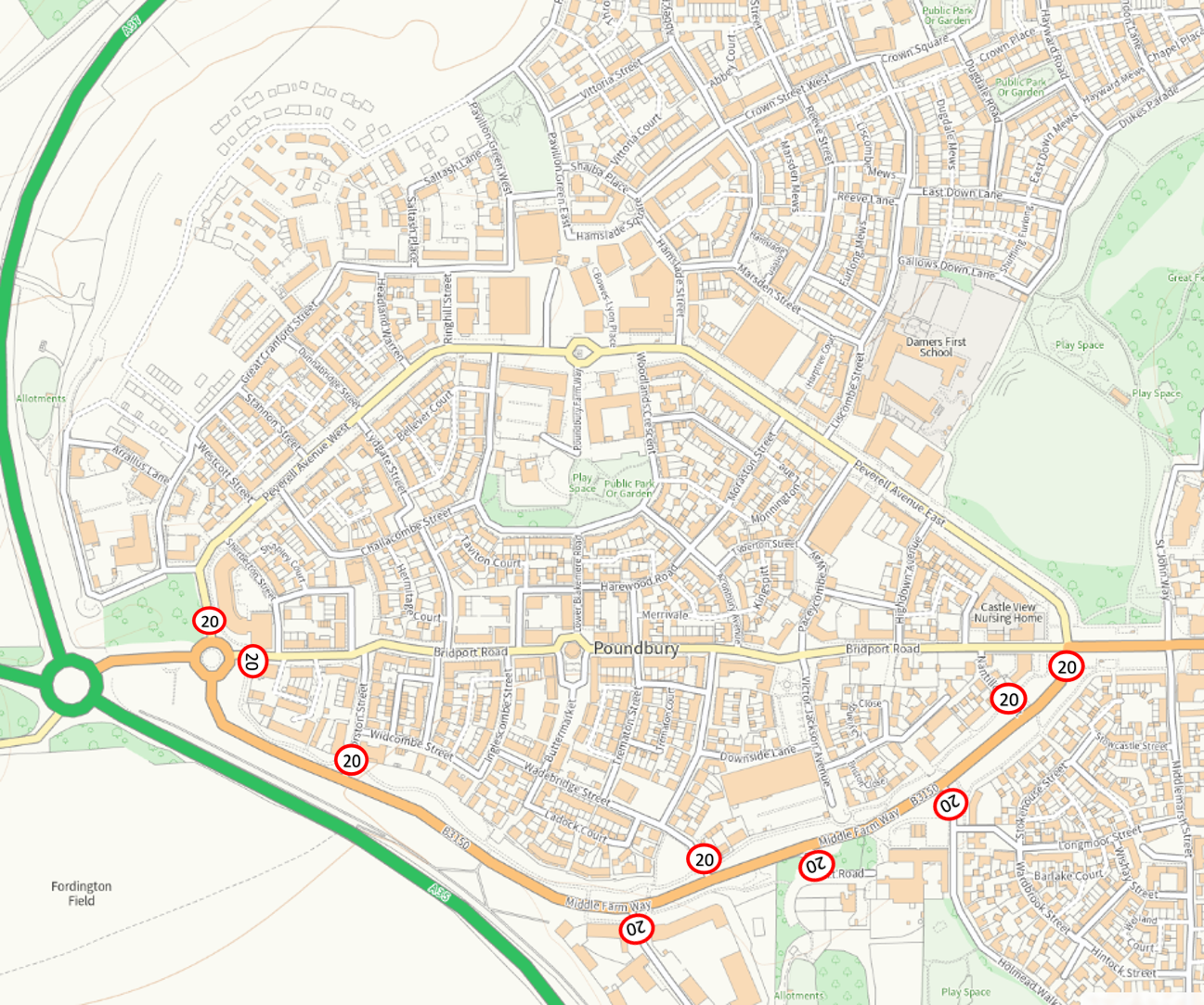
20mph Signage Start / End Points in Poundbury
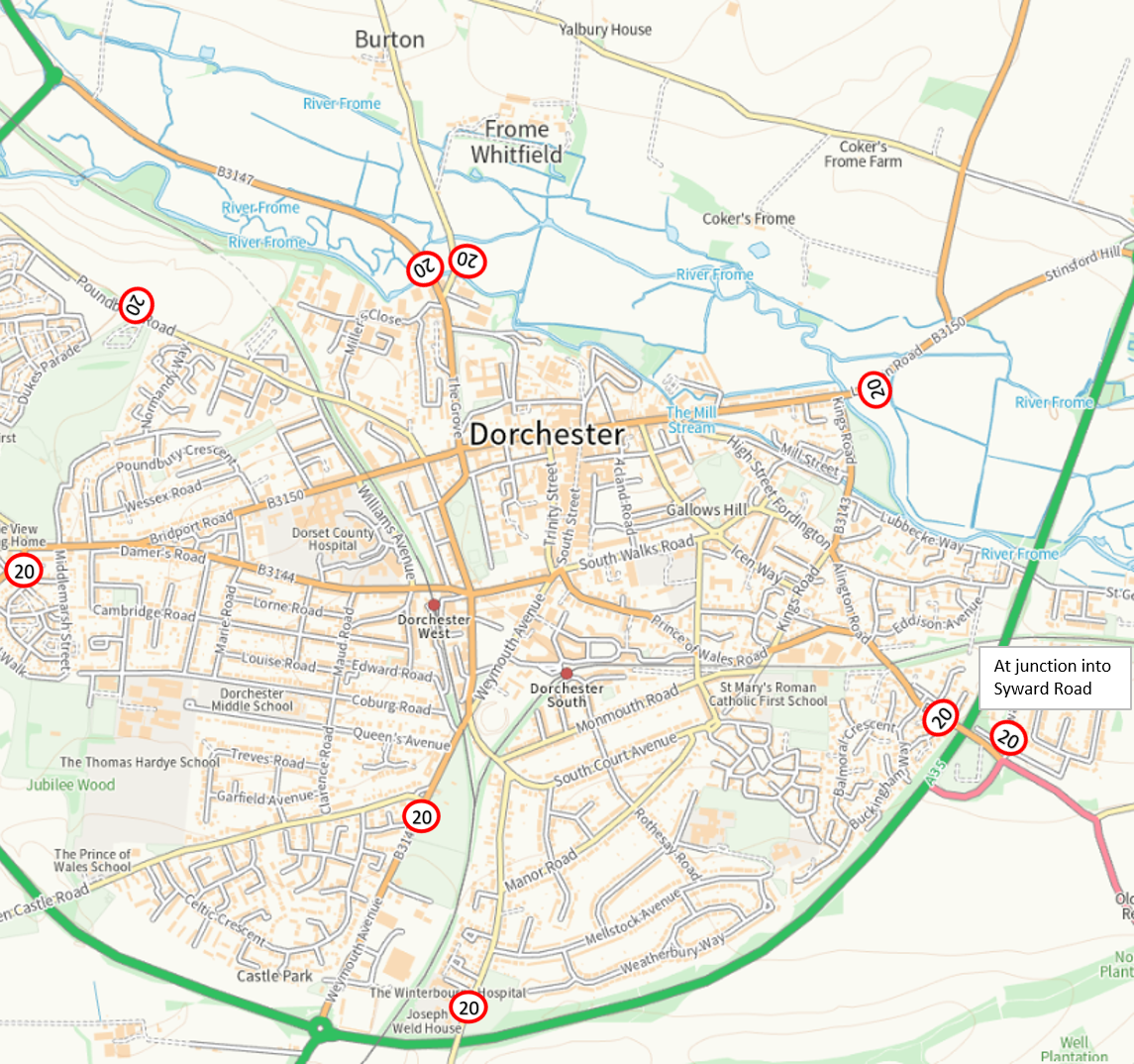
Signage Start / End Points in Dorchester
Why it is Being Proposed?
- High public support for 20mph limits in urban and residential areas.
- Helps balance the needs of drivers, cyclists, pedestrians and the local community.
- Benefits for children, older and vulnerable people.
Proven Safety Benefits
Research shows that 20mph limits can:
- Reduce road crashes by up to 42%. (BMJ, 2009)
- Cut fatalities and serious injuries by 24% (UK Parliament, 2024)
- Reduce pedestrian accidents and the severity of injuries.
- Deliver safety benefits even with simple sign-only schemes. (Science Direct, 2025)
Environmental Benefits
- Lower speeds can help reduce air pollution.
- Creates a more people-friendly environment with less traffic dominance.
Encouraging Healthier Travel
- Makes walking and cycling feel safer and more attractive.
- Creates quieter, more pleasant neighbourhoods.
- Improves driver awareness and reaction time.
- Supports healthier and more active lifestyles.
Evidence from Dorchester
- Resident feedback regarding speeding in residential areas.
- Strong local resident support for the consultation.
- Average traffic speeds in some areas are higher than desirable for residential streets.
What would a 20mph speed limit mean for signage?
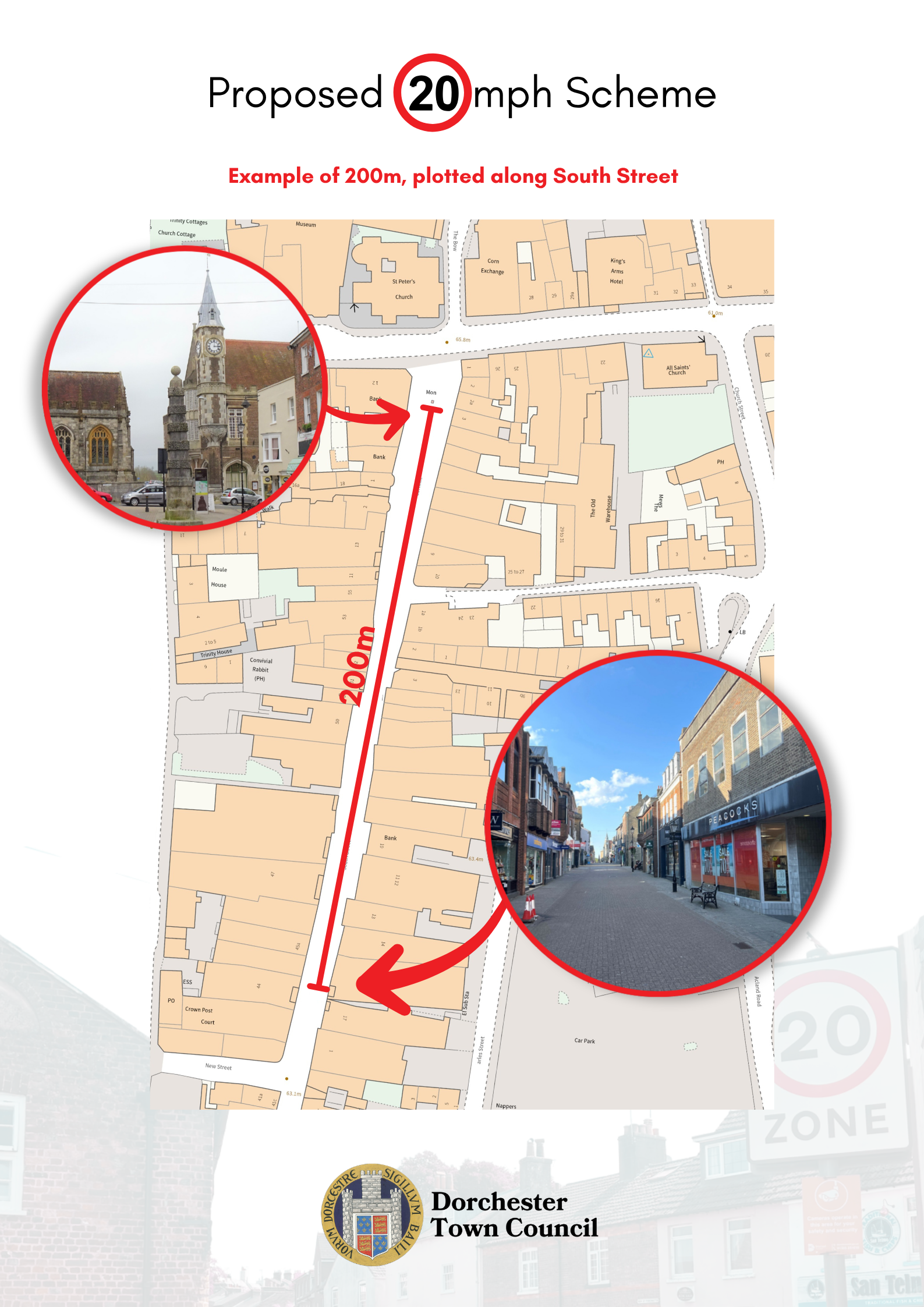
If a town-wide 20mph speed limit is approved, additional speed limit signs would be required throughout Dorchester. Current regulations mean that 20mph limits must be supported by repeater signs placed at regular intervals—typically around every 200 metres.
At present, many roads in Dorchester do not require regular speed limit signs because the street lighting system legally indicates a default 30mph limit. Introducing a 20mph limit would therefore result in a noticeable increase in highway signage across the town.
Residents may wish to consider the benefits of a lower speed limit alongside the visual impact of additional signs when sharing their views during the consultation.
The image below illustrates what 200 metres looks like in practice, using two well-known reference points in Dorchester as reference points. This is approximately the spacing at which repeater signs would typically be installed within a 20mph speed limit area.
TO TAKE PART IN THE SURVEY
We want to hear your views – your valuable feedback will help shape the future of Dorchester’s streets and public spaces.
ONCE THE CONSULTATION CLOSES
The consultation will close at 23:59 on 7 September 2026. Subject to community support, Dorset Council will consider a formal application and consult relevant stakeholders before deciding whether the scheme can move forward.
The agendas and minutes for the Planning & Environment Committee can be viewed on the Committees page of this website.
The Planning and Environment Committee plays a key role in shaping Dorchester’s future by:
- Reviewing planning applications and sharing comments with Dorset Council (the Local Planning Authority).
- Advising on important local issues, including:
- Environmental protection and improvements.
- Traffic management and road safety.
- Public transport services around the town.
- Commenting on footpaths, bridlepaths, and rights of way, helping to maintain and improve local access routes.
- Making suggestions on new street names when needed.
The Committee also:
- Reviews major development proposals that could impact Dorchester’s environment and reports findings to the full Council.
- Provides feedback on the Local Development Plan — the long-term planning blueprint for the area.
- Identifies developments that would bring real benefits to Dorchester.
Planning applications for Dorchester are discussed at the Planning & Environment Committee, which usually meets on the first Monday of each month.
Meeting details are available in the Council Calendar, and the agenda for each meeting is published under the Committees tab at least three days before the meeting.
One week before the agenda is published, a list of the planning applications received to date is posted on the website.
Members of the public are welcome to comment on any applications at the Committee meeting.
If you would like to attend a meeting or have your say, please contact the Committee Clerk, Georgina Wakely, at G.Wakely@dorchester-tc.gov.uk.
Please note:
Dorchester Town Council carefully considers and comments on all planning applications affecting the town. However, we are a consultee in the planning process. Final decisions are made by the Planning Authority, Dorset Council.
Dorchester Town Council continues to strongly object to policy DOR13 (previously DOR15), recognising that this specific site carries a significant level of risk that it will fail to address the local needs of the town, nor will it produce a comprehensive, relevant, viable and sustainable development that supports the area’s future rather than destabilising it. The Council's response to the October 2025 Dorset Local Plan Consultation can be downloaded here.
At the Full Council Meeting on 28 November 2022, the council agreed to adopt the Dorchester Town Council Town Centre Masterplan, which will be presented to Dorset Council when the local 'DOR' policies are considered during the Local Plan consultation.
Dorset Highways, part of Dorset Council, is the Highway Authority for Dorchester and is responsible for most highway improvements across the county.
Submitting Requests
Dorset Council does not accept direct requests for highway improvements from individual residents. Instead, all requests must be submitted through the relevant Parish or Town Council. If Dorchester Town Council supports a request, it will be forwarded to Dorset Council for consideration.
Assessment Process
Each proposal is carefully reviewed against Dorset Council’s ranking criteria, which include:
- Road hierarchy (type of road)
- History of collisions (Please report all non-injury Collisions and Near-Misses to Dorset Council. This data strengthens cases for Highway Improvement Requests)
- Local conditions (e.g. proximity to schools or hospitals)
- Duration of the problem
- Access issues for emergency services or public transport
- Carriageway width
Some of these factors require supporting evidence. In addition, certain types of restrictions will need to show significant support from local residents.
Funding Limitations
Dorset Council has a very limited budget for new highway schemes and can only introduce a small number of improvements compared to previous years.
How to Submit a Request
Residents wishing to request highway improvements should:
- Complete Highway Improvements Request Form
- Provide all required evidence — Incomplete forms will be returned for additional information.
- Consult with your local ward councillors — This helps with an initial assessment before submission.
Completed forms will be reviewed at a scheduled Planning and Environment Committee meeting. The applicant will be notified when their request is due to be considered and invited to attend the meeting. A representative from Dorset Highways may also be present to offer advice.
Dorset Highways, part of Dorset Council, acts as the Highway Authority for Dorchester and is responsible for introducing on-street parking restrictions across Dorset.
Submitting Requests
Dorset Council does not accept direct requests for new parking restrictions from individual residents. All requests must be channelled through the relevant Parish or Town Council. If Dorchester Town Council supports a request, it will be forwarded to Dorset Council for consideration, following the published Dorset Council guidance.
Assessment Process
Dorset Council assesses each proposal against a range of criteria, including:
- Road hierarchy (type of road)
- History of collisions
- Local conditions (e.g., proximity to schools or hospitals)
- Duration of the problem
- Access issues for emergency services or public transport
- Carriageway width
Supporting evidence may be required for some of these factors. Additionally, certain types of restrictions must demonstrate support from a significant number of local residents.
Funding and Prioritisation
Due to budget constraints, Dorset Council can only introduce a limited number of new parking restrictions compared to previous years.
Dorchester Town Council Process
The Planning and Environment Committee considers residents' requests for parking restrictions up to twice a year, usually in the autumn, to ensure supported proposals can be submitted to Dorset Council by the end of October.
How to Submit a Request
Residents wishing to request new parking restrictions should:
- Complete the Parking Restriction Request Form.
- Include all necessary evidence — Incomplete forms will be returned for additional information.
- Consult with your local ward councillors — They can assist with an initial assessment before submission.
Completed forms will be reviewed at the next scheduled Planning and Environment Committee meeting. Residents will be informed when their request is due to be considered and invited to attend the meeting. A Dorset Highways officer may also attend to provide advice.